
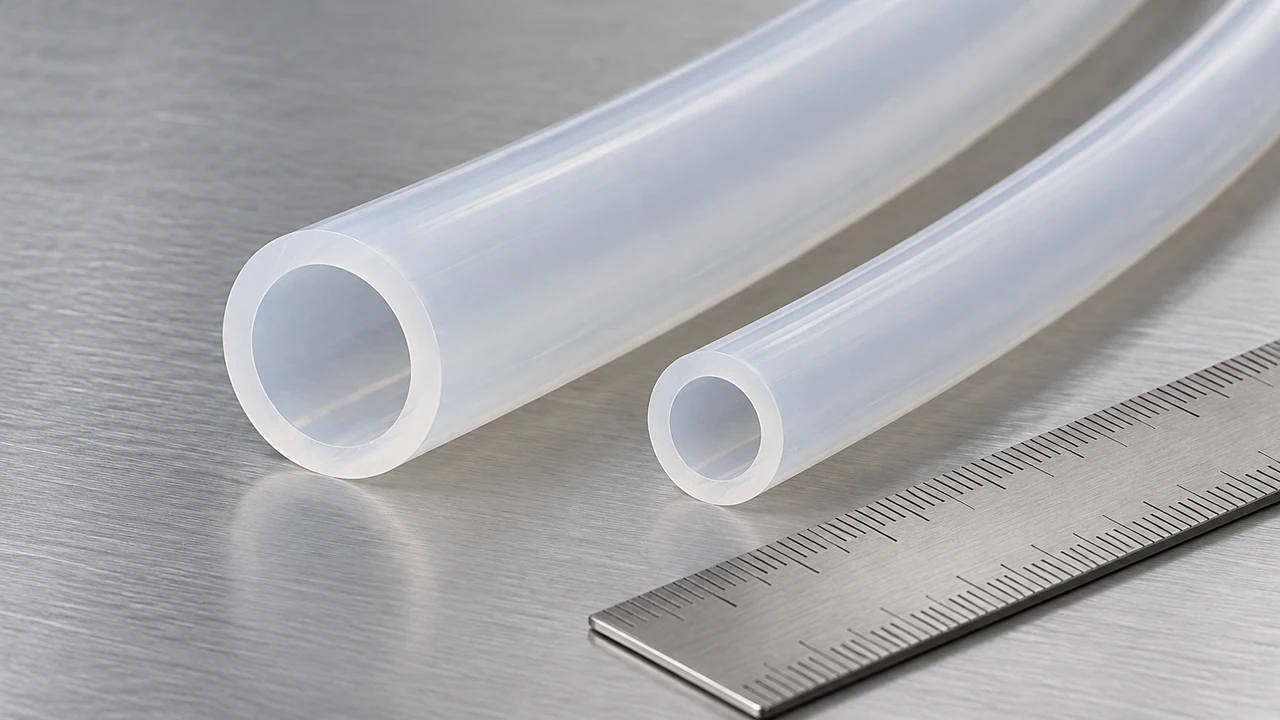
When providing silicone tubing dimensions, saying “5 mm tubing” alone is not enough. Does this value refer to the inside or outside diameter? Specify both diameters with their units so the connection and installation assessment starts correctly.
What do inside and outside diameter mean?
Inside diameter is the diameter of the circular opening inside the tube. This measurement is used when assessing the connector and the flow path in the application. Outside diameter is the measurement across the tube's outer boundaries; it is considered together with the hole, channel, holder or other equipment it passes through.
To avoid confusion when writing dimensions, use a clear description such as “inside diameter 3 mm, outside diameter 5 mm”. If you write only “3 × 5”, also specify which value is the inside diameter and which is the outside diameter.
How is wall thickness calculated?
For circular, concentric tubing with a uniform wall, geometric wall thickness is calculated as follows:
For an example with an inside diameter of 3 mm and outside diameter of 5 mm: (5 − 3) / 2 = 1 mm.
This example explains only the dimensional calculation; it does not describe a specific stock product or its pressure resistance. Different materials and operating conditions may apply to the same diameter values. Check your calculation with the tubing dimension calculator.
What should you check when measuring a sample?
- Do not compress soft tubing with the calliper jaws.
- Ensure the cut end is clean and circular.
- Identify samples that have been crushed, stretched or deformed during use.
- Check measurements at several points and note any significant differences.
- Include the length or total metres alongside the inside and outside diameters.
If the tubing needs to fit over a particular connector, also share a dimensioned photo of the connector end. Fit and fixing method cannot be confirmed using tubing dimensions alone.
Short answers about tubing dimensions
If the inside diameter is 5 mm and the outside diameter is 8 mm, what is the wall thickness?
For a concentric tube with uniform walls, (8 − 5) / 2 = 1,5 mm. Write the inside and outside diameters separately to clarify the meaning of “5 × 8 mm”.
Does wall thickness alone indicate suitability for use?
No. Material and hardness, operating conditions and equipment information are also assessed. You can support your enquiry with a dimensioned drawing or an annotated photo.
Add operating conditions to the diameter information
Operating temperature, pressure or vacuum, the fluid in contact, cleaning method and equipment type should be assessed together. A geometric wall thickness calculation does not determine working pressure, vacuum suitability or service life.
Presenting your enquiry in the order “inside diameter + outside diameter + length / metres + quantity + operating conditions” makes the information easier to read. Share your dimensions and application details with us.