
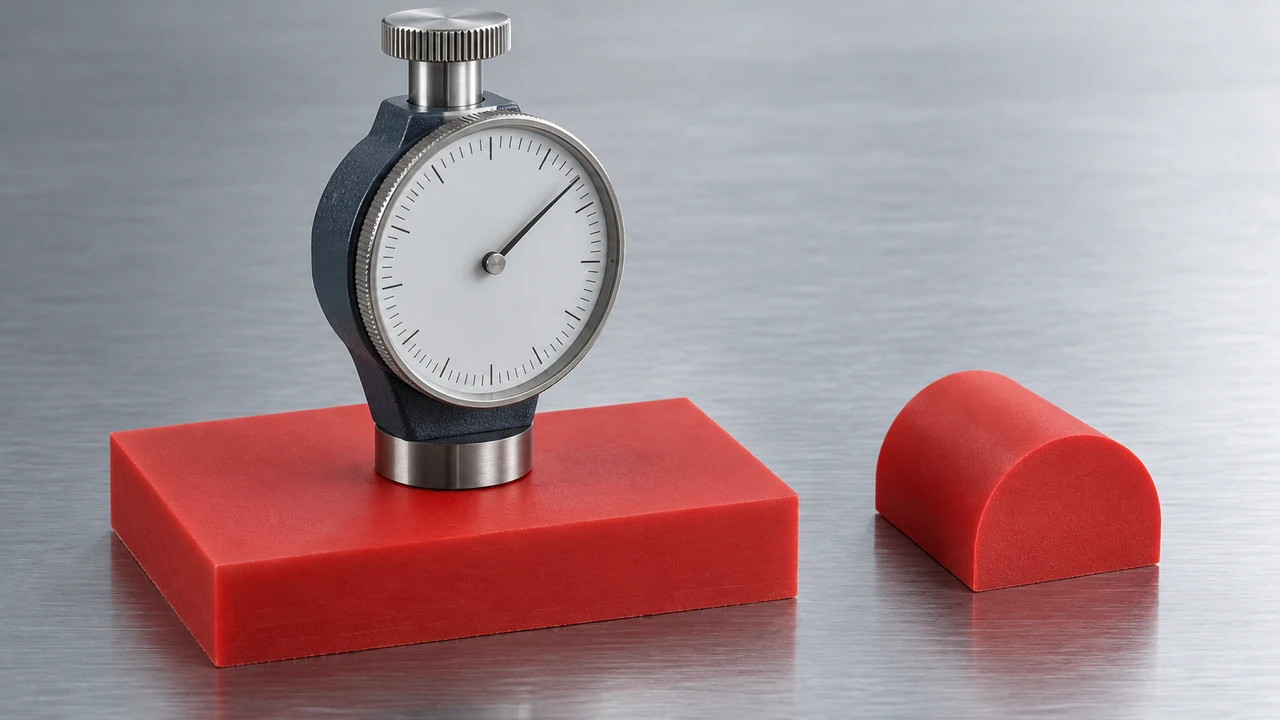
Hardness in silicone product enquiries is often specified as a “Shore A” value. This hardness measurement expresses the material's resistance to local indentation by a standardised indenter. A single number is a useful starting point for product selection; it does not explain every aspect of behaviour in an application.
How should the Shore A value be interpreted?
On the same hardness scale, a higher value indicates a harder material. A seal with lower hardness generally requires less compression force to achieve appropriate compression. However, the profile shape and contact area also affect the result; comparing different cross-sections using only the hardness number is not sufficient.
Do not treat Shore A as directly equivalent to other hardness scales. Include both the scale name and value in your enquiry. “70 Shore A” is clearer than simply “70 hardness”.
The same hardness, different cross-sections
Solid D, hollow box and open U-channel profiles have different geometries. Even with the same material hardness, their wall structures, internal cavities and installation methods differ. How the product closes, flexes or grips the mating component is assessed separately.
Our data sheets for profiles 20003, 20088, 21720 and 30007 specify a hardness of 70 Shore A . This does not mean that the same hardness should be selected for every application.
Which questions should be answered for selection?
- Which surface does the part contact, and in which direction?
- How is the channel or mating component that supports the profile dimensioned?
- What movement is expected during closing and compression?
- What are the normal operating and cleaning temperatures?
- Which fluid or chemical does the material contact, and for how long?
Alongside this information, share the existing product's hardness, your colour requirements and any technical specification. Increasing hardness does not automatically make the product more durable or suitable in every respect.
Short answers about Shore A hardness
Is harder silicone always better?
Suitability does not depend on hardness alone. Closing force, cross-section, contact and operating conditions are assessed together. Comparing profile cross-sections complements this assessment.
Does colour indicate hardness or suitability?
Colour alone does not indicate hardness, food-contact suitability or chemical resistance. Specify these requirements technically. For tubing applications, include inside and outside diameter information as well.
Clarify the enquiry with measurement information
If sharing a measurement result, also include the scale, method and sample information. The measuring instrument in the photo is illustrative; it does not show a test result for a specific product. Do not estimate an exact hardness value from the behaviour of a curved profile.
View the visual material guide or send your cross-section and operating conditions. Let's assess the hardness information together with your application.