

ÇINAR SİLİKON · MANUFACTURING TECHNOLOGY
Silicone
extrusion
manufacturing.
Manufacturing that starts with your cross-section
and extends to your application.
Profiles, tubing, cords and strips. Let’s review your technical drawing, material requirements and operating conditions together.
WHAT IS EXTRUSION?
One die.
A continuous cross-section.
Extrusion shapes silicone compound into a uniform cross-section along its length by forcing it through a die.
This cross-section defines the bore of a tube, the diameter of a cord or the channel in a profile. The product is then cured; length, coiling and finishing options are assessed to suit the application.
A good starting point goes beyond a single dimension; it means sharing where and how the product will work with us.
FROM COMPOUND TO PRODUCT
Five stages
of production.
Select the stages to explore
how the material becomes a finished product.
Material selection for the application
The operating environment, target hardness and colour requirements are assessed together. Silicone compound suitable for extrusion is prepared for production.
The die defines the cross-section
The die geometry shapes the profile's outer form and any internal cavities. Critical dimensions and mounting surfaces should be clearly identified in the technical drawing.
From compound to a continuous cross-section
The screw system feeds the silicone compound towards the die. The material emerging from the die forms a continuous product with a uniform cross-sectional geometry along its length.
The shaped silicone becomes elastic
The extruded product is cured using a suitable heat treatment. Conditions determined by the material system and cross-sectional geometry allow the silicone to develop its elastic properties.
Dimensions, length and delivery format
The product is assessed against the dimensional, surface and length requirements specified for the project. Cutting, coiling or joining requirements are agreed at the quotation stage.
LET'S DEFINE YOUR CROSS-SECTION TOGETHER
The same principle.
Different geometries.
Select a product type.
See the technical information required.
ROUND CROSS-SECTION
One diameter. A clear starting point.
Diameter, hardness and operating conditions are the key selection criteria for solid round cord.
- Outside diameter and critical tolerance
- Operating temperature and contact media
- Total length, cut length and colour
HOLLOW CROSS-SECTION
Two diameters considered together.
Inside diameter, outside diameter and wall thickness are interrelated. Tubing is selected with the conveyed medium and connection method in mind.
- Inside and outside diameter
- Wall thickness and connection method
- Contact media, hardness and length
RECTANGULAR CROSS-SECTION
Balancing width and thickness.
For flat strips, cross-sectional dimensions are assessed according to the contact area and required compression.
- Width × thickness
- Contact surface and installation clearance
- Cut length or coil preference
APPLICATION-SPECIFIC CROSS-SECTION
The cross-section is shaped by the installation.
For U, T, L, D, box and lip profiles, overall dimensions are only part of the assessment. The channel, direction of contact and compression allowance are also considered.
- Dimensioned cross-section or sample
- Channel and contact surfaces
- Critical dimensions and installation orientation
Have a custom cross-section? A technical drawing or sample is a useful starting point for assessment.
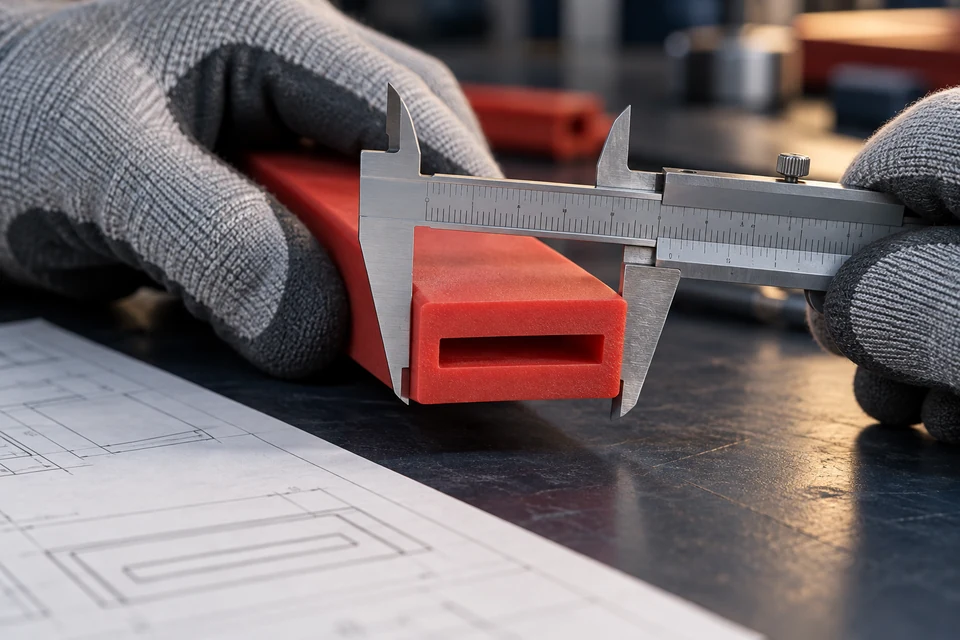
FROM DRAWING TO INSTALLATION
Fit matters
as much as dimensions.
A profile performs correctly when the technical drawing and installation conditions are considered together.
Critical dimensions and tolerances
Dimensions such as channel width, wall thickness and inside and outside diameter are assessed according to the cross-section and operating conditions.
Hardness and operating environment
Required compression, temperature, contact media and movement guide material selection.
Surface, length and finishing
It is useful to clarify surface requirements, cut lengths, coiling or joining needs at the start of the project.
READY FOR A TECHNICAL ASSESSMENT?
A good quotation
starts with the right information.
Tick the information you already have. We can clarify any missing details together.
No drawing? Let's start with your sample.
A cross-section photo and an image of the installation area also help with the initial assessment.
Your selections are added to a draft message. You can edit it before sending.
COMMON QUESTIONS
Clarify the details
before production.
Frequently asked questions about cross-sections, materials and order planning.
View all questionsWhich silicone products can be extruded?
Silicone profiles, tubing, solid cords and flat strips with a constant cross-section along their length are typical products made by this method. The feasibility of custom cross-sections is determined through technical assessment.
Can I request a quotation without a technical drawing?
Yes. An initial assessment can be made using a sample, a dimensioned cross-section photo and an image of the installation area. Providing critical dimensions and the required length also helps the process.
Does the same tolerance apply to every cross-section?
Cross-sectional geometry, dimensions, hardness and application may require different tolerance approaches. Please identify critical dimensions, particularly those affecting installation, so production feasibility and tolerances can be assessed for your project.
Can I choose the hardness and colour?
You can include your hardness and colour requirements with your project details. Suitable options are assessed according to the cross-section, material and operating conditions.
How are total length, cut length and lead time determined?
Specify the total quantity required, the desired length and your target delivery date. Minimum quantity and lead time are confirmed at the quotation stage according to the die, material, cross-section and production schedule.
What if I have a special application, such as food contact?
Share the contact media and required documentation or standards at the outset. Material and production suitability must be assessed separately against the conditions of the specific application.
LET'S ASSESS YOUR CROSS-SECTION TOGETHER