
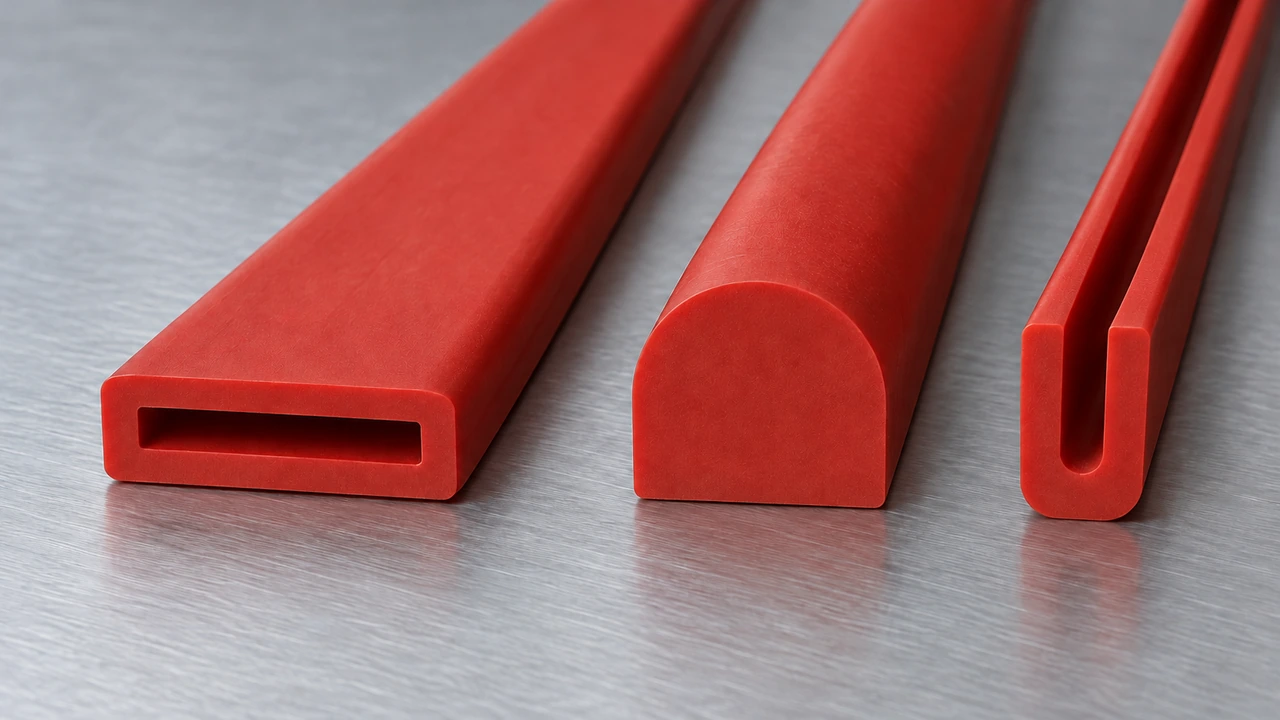
The outer shape is often the first feature considered when selecting a silicone profile. Yet two cross-sections with similar outer dimensions may differ in their internal cavity, channel opening and contact surface. The right starting point is to assess the profile's cross-section together with the mating component in the equipment.
How do the three basic cross-sections differ?
Solid cross-section
A solid profile has no enclosed internal cavity. A D cross-section combines a flat base with a rounded upper surface. For selection, specify not only the width, but also the overall height, contact surface and closing direction. Being solid does not automatically make it more suitable for every application.
Hollow cross-section
A box profile has a rectangular exterior with an enclosed internal cavity. Alongside the overall width and height, the cavity dimensions also define the cross-section. Measuring only the outer boundary of an old sample may overlook this internal structure.
Channelled cross-section
A U-channel profile has an opening to the outside. The thickness of the mating component that fits into the channel, the channel opening and seating depth are assessed together. Similar outer dimensions do not mean two U profiles will fit the same metal edge.
Three examples from our technical data sheets
| Profile | Cross-section | Nominal outer dimensions | Additional information |
|---|---|---|---|
| 20003 | Box | 26 × 11 mm | Internal cavity: 18 × 3 mm |
| 20088 | Solid D | 14 × 15 mm | No enclosed internal cavity |
| 21720 | U-channel | 4 × 9,5 mm | Nominal channel opening: 1 mm |
These values are example dimensions from the relevant profile data sheets. Let's also assess your application's installation area and operating conditions. View the dimensioned technical data sheets.
What information should you share for selection?
- Cross-section photo or dimensioned drawing of the existing product.
- Dimensions of the channel, sheet metal, cover or surface on which the profile sits.
- Contact and closing direction; corner and joint details.
- Temperature, pressure or vacuum, and contact substances.
- Length / metres, production quantity, hardness and colour requirements.
Do not assume the dimensions of a deformed sample are the correct dimensions for new production. Sharing both the sample and the equipment's mating dimensions helps define the target cross-section. Use a calliper without compressing the soft part, and show in the photo which dimension is being measured.
Short answers about silicone profile selection
Can a profile be selected from a photo alone?
A photo helps identify the cross-section; it does not confirm dimensions, tolerances and installation fit on its own. Add a dimensioned cross-section and mating component information to the image.
Do two profiles of the same hardness perform in the same way?
The cross-section, internal cavity, walls and contact area may differ. Shore A hardness should be assessed alongside geometry. For a channelled part, installation dimensions should also be provided.
Let's identify a cross-section for your application together
If you know a standard profile number, include it in your enquiry. Otherwise, you can start with a cross-section photo and installation information. Send your drawing or application photo; let's assess the product, dimensions and material together.